
EHT Deputy Project Scientist awarded a £4 million Faraday Discovery Fellowship
EHT Deputy Project Scientist, Dr Kazunori Akiyama, has been awarded a £4 million Faraday Discovery Fellowship by the United Kingdom's Royal Society. The project (TomoGrav) will deliver our first dynamic 3D views of the plasma environments surrounding black holes. These 3D tomographic visualizations will help Akiyama's team discern the physics of how energy is channeled near black holes and how spacetime is warped in these extreme. gravity environments.
£4M Faraday Discovery Fellowship Awarded to EHT Deputy Project Scientist, Kazunori Akiyama
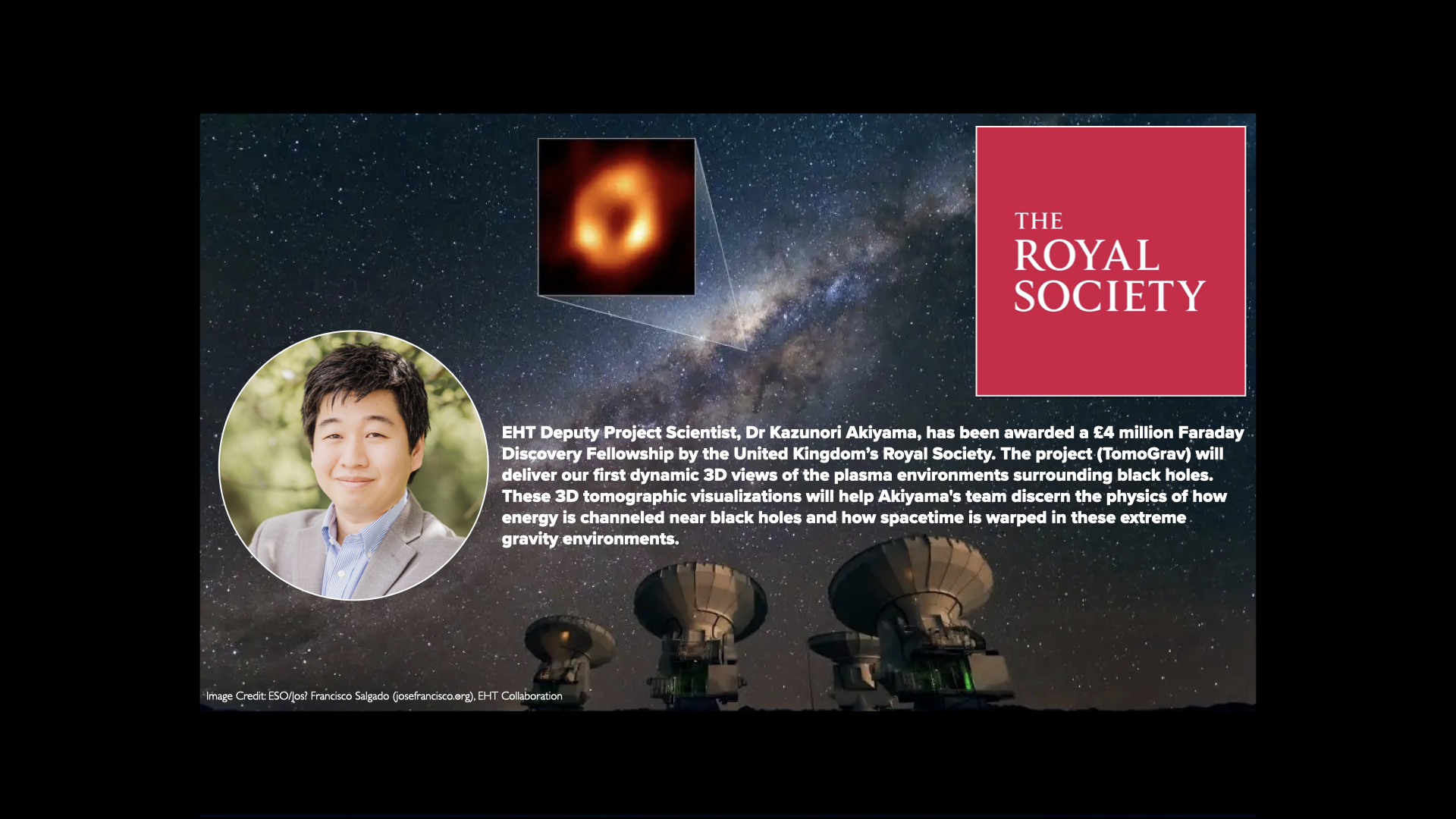
The Event Horizon Telescope (EHT) Deputy Project Scientist, Dr. Kazunori Akiyama, has been awarded a £4 million Faraday Discovery Fellowship by the United Kingdom’s Royal Society, to be hosted by Heriot-Watt University in Scotland. The project, named TomoGrav, brings together Dr. Akiyama’s pioneering expertise in black hole imaging and cutting-edge artificial intelligence (AI) algorithms developed by EHT Collaboration member Prof. Yves Wiaux at Heriot-Watt University.
The TomoGrav project aims to enable what the team has termed “dynamic gravitational tomography”. Rather than producing a 2D snapshot image on sky, the project will deliver dynamic 3D views of how plasma flows and evolves around black holes over time, revealing how energy is channelled and how spacetime is warped by extreme gravity.
The team will develop advanced AI techniques to create high-resolution 3D movies of plasma surrounding M87* and Sgr A* using forthcoming EHT data. The project will also help shape future EHT upgrades, including the proposed Black Hole Explorer (BHEX) mission extending EHT into space.
The project represents an encounter between two scientific communities. While the radio astronomy community builds exquisite telescopes to observe black holes, the computational imaging community’s expertise will be key to delivering the most advanced AI-powered imaging algorithms capable of forming high-resolution 3D movies of black holes.
Beyond astronomy, the same AI techniques will enable dynamic imaging of the heart with an unprecedented combination of precision and speed, reducing scan times for patients and lowering healthcare costs. They will also enhance Earth monitoring systems, improving sea-level measurements and advancing our understanding of climate change.
The fellowship will see Dr. Akiyama move from his current position as a Research Scientist at MIT Haystack Observatory in the United States to Heriot-Watt University in the UK, as part of a scheme designed to provide long-term support to outstanding mid-career researchers.
Dr. Akiyama’s move to Heriot-Watt follows the recent announcement that another EHT scientist, Prof. Sera Markoff, will join the University of Cambridge. Together, these new arrivals to the UK will significantly strengthen and expand the nation’s research community built around EHT, with close collaboration on the TomoGrav project.
Dr. Akiyama and Prof. Wiaux are supported by a multidisciplinary team of 10 international partners from across the world, whose combined expertise in black hole science and computational imaging is second to none. This partnership includes EHT Project Scientist Prof. Mariafelicia De Laurentis, EHT Science Board member Prof. Sera Markoff, EHT Gravitational Physics Working Group Coordinator Dr. Ziri Younsi, and BHEX’s Principal Investigator and former EHT Science Council Chair Dr. Michael Johnson.
Further information: Press Release from Heriot-Watt University, Announcement from The Royal Society