# Global Web Tour of EHT Observatories
March 25, 2019
- [ Blog ](/news-categories/blog)
The Event Horizon Telescope is a global network of synchronized radio observatories that work in unison to observe radio sources associated with black holes with angular resolution comparable to their event horizons. The required extreme resolving power makes scientists and engineers go to some of the most extreme environments on the Earth to collect data. On EHT social media pages, [Twitter](https://twitter.com/ehtelescope) and [Facebook](https://www.facebook.com/ehtelescope), and in this blog post we are taking you on a tour to the 8 observatories that participated in acquisition of the 2017 EHT data, as well as to another 3 that will will be a part of this daring endeavor beyond 2017. Find them all on this [interactive map](/array) here on the official EHT website!
**Eight observatories that participated in EHT observations in 2017 (and later):**
Sort 
**Atacama Pathfinder Experiment (APEX)**
Cerro Chajnantor, Chile
altitude: 5,100 m
single dish, 12-m diameter
web: [Tw](https://twitter.com/hashtag/APEX), [Fb](https://www.facebook.com/Atacama-Pathfinder-EXperiment-APEX-141984649180307/), [www.eso.org/apex](/www.eso.org/apex)
Operated by the European Southern Observatory ([ESO](https://www.eso.org/public/), [@ESO](https://twitter.com/ESO), [@ESOAstronomy](https://www.facebook.com/ESOAstronomy)) on behalf of Max Planck Institut fuer Radioastronomie (MPIfR, [@maxplanckpress](https://twitter.com/maxplanckpress), [@maxplancksociety](https://www.facebook.com/maxplancksociety)), Onsala Space Observatory ([@OnsalaRymd](https://twitter.com/OnsalaRymd), [@onsalarymd](https://www.facebook.com/onsalarymd)), and ESO itself.
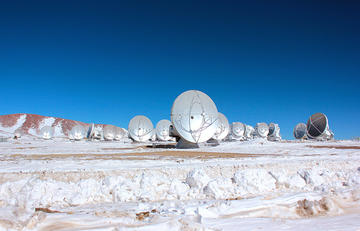
**Atacama Large Millimeter/submillimeter Array (ALMA)**
Cerro Chajnantor, Chile
altitude: about 5,000 m
array of fifty-four 12-m diameter and twelve 7-m diameter dishes
web: [Tw](https://twitter.com/almaobs), [Fb](https://www.facebook.com/ALMA.radiotelescope),
ALMA is the result of an international association between Europe ([ESO](https://www.eso.org/public/), [@ESO](https://twitter.com/ESO), [@ESOAstronomy](https://www.facebook.com/ESOAstronomy)), North America (NRAO, [@TheNRAO](https://twitter.com/TheNRAO), [@TheNRAO](http://www.facebook.com/@TheNRAO)) and East Asia ([NAOJ](https://www.nao.ac.jp/en/), [@naoj.eng](https://twitter.com/naoj.eng), [@prcnaoj\_en](http://www.facebook.com/prcnaoj_en)), in collaboration with the Republic of Chile.

**IRAM 30-meter Telescope**
Pico Veleta, Spain
altitude: 2,850 m
single dish, 30-m diameter
web:
Operated by Institut de Radioastronomie Millimétrique ([IRAM](https://www.iram-institute.org/)), a collaboration between Centre National de la Recherche Scientifique ([CNRS](http://www.cnrs.fr/), [@CNRS](https://twitter.com/CNRS), [@CNRS.fr](http://www.facebook.com/CNRS)), [Max-Planck-Gesellschaft](https://www.mpg.de/en) ([@maxplanckpress](https://twitter.com/maxplanckpress), [@maxplancksociety](https://www.facebook.com/maxplancksociety)), and Instituto Geográfico Nacional ([IGN](http://www.ign.es/web/ign/portal), [@IGNSpain](https://twitter.com/IGNSpain), [@IGNSpain](https://www.facebook.com/IGNSpain)).
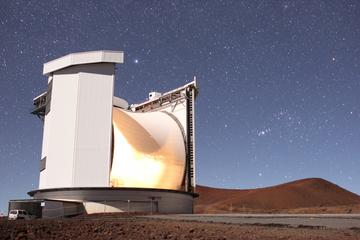
**James Clerk Maxwell Telescope (JCMT)**
Maunakea, Hawaii, USA
altitude: 4,100 m
single dish, 15-m diameter
web: [Tw](https://twitter.com/eao_jcmt), [Fb](https://www.facebook.com/EAObservatory),
Operated by East Asia Observatory ([EAO](https://www.eaobservatory.org), [@EAObservatory](https://www.facebook.com/EAObservatory)) on behalf of [National Astronomical Observatories, Chinese Academy of Sciences](http://www.cas.cn), National Astronomical Observatory of Japan ([NAOJ](https://www.nao.ac.jp/en/), [@naoj.eng](https://twitter.com/naoj.eng), [@prcnaoj\_en](http://www.facebook.com/prcnaoj_en)), Korea Astronomy and Space Science Institute ([KASI](https://www.kasi.re.kr), [@kasi.re.kr](https://www.facebook.com/kasi.re.kr)), and Academia Sinica Institute for Astronomy and Astrophysics ([ASIAA](https://www.asiaa.sinica.edu.tw/), [@epo\_asiaa](https://twitter.com/epo_asiaa), [@asiaa.tw](https://www.facebook.com/asiaa.tw)). EAO also partners with Vietnam, Thailand, Malaysia, India and Indonesia.
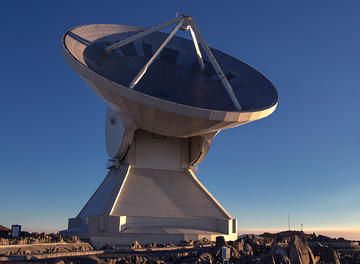
**Large Millimeter Telescope "Alfonso Serrano" (LMT)**
Sierra Negra, Mexico
altitude: 4,600 m
single dish, 50-m diameter
web: [Tw](https://twitter.com/gtmlmt_oficial), [Fb](http://www.facebook.com/gtmlmt.oficial),
Operated by Instituto Nacional de Astrofísica, Óptica y Electrónica ([INAOE](https://www.inaoep.mx/), [@inaoe\_mx](https://twitter.com/inaoe_mx), [@inaoe.oficial](http://www.facebook.com/inaoe.oficial)) and the [University of Massachusetts](https://www.umass.edu/) ([@UMassAmherst](https://twitter.com/UMassAmherst), [@UMassAmherst](https:/www.facebook.com/UMassAmherst)).

**Submillimeter Array (SMA)**
Maunakea, Hawaii, USA
altitude: 4,100 m
array of eight 6-m diameter dishes
web:
Operated by the Smithsonian Astrophysical Observatory ([SAO](https://www.cfa.harvard.edu/sao), [@saoastro](https://twitter.com/saoastro), [@HarvardSmithsonianCenterForAstrophysics](https://www.facebook.com/HarvardSmithsonianCenterForAstrophysics)) and the Academia Sinica Institute of Astronomy and Astrophysics ([ASIAA](https://www.asiaa.sinica.edu.tw/), [@epo\_asiaa](https://twitter.com/epo_asiaa), [@asiaa.tw](https://www.facebook.com/asiaa.tw)).
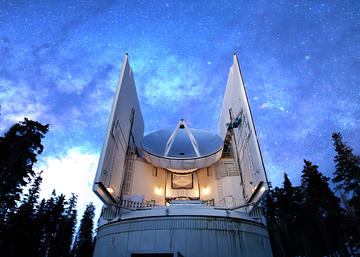
**Submillimeter Telescope (SMT)**
Mount Graham, Arizona, USA
altitude: 3,100 m
single dish, 10-m diameter
web:
Operated by the [University of Arizona](https://www.arizona.edu/) ([@UofA](https://twitter.com/UofA), [@uarizona](https://www.facebook.com/uarizona)) through the Arizona Radio Observatory ([ARO](http://aro.as.arizona.edu/)).
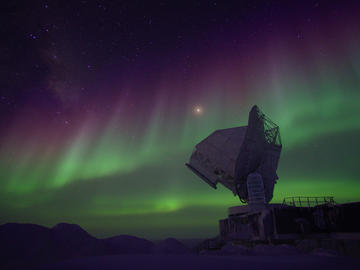
**South Pole Telescope (SPT)**
South Pole Station, Antarctica
altitude: 2,800 m
single dish, 10-m diameter
web: [Tw](https://twitter.com/SPTelescope),
Operated by a collaboration led by the [University of Chicago](https://www.uchicago.edu/) ([@UChicago](https://twitter.com/UChicago), [@uchicago](https://www.facebook.com/uchicago)), with EHT instrumentation provided by the [University of Arizona](https://www.arizona.edu/) ([@UofA](https://twitter.com/UofA), [@uarizona](https://www.facebook.com/uarizona)).
**One additional observatory that participated in EHT observations in 2018 (and later):**
Sort 
**The Greenland Telescope (GLT)**
Thule Air Base, Greenland, Denmark
altitude: 77 m
single dish, 12-m diameter
web: [Tw](https://twitter.com/hashtag/GreenlandTelescope),
[https://www.cfa.harvard.edu/greenland12m](https://www.cfa.harvard.edu/greenland12m/)
Operated by the Academia Sinica Institute of Astronomy and Astrophysics ([ASIAA](https://www.asiaa.sinica.edu.tw/), [@epo\_asiaa](https://twitter.com/epo_asiaa), [@asiaa.tw](https://www.facebook.com/asiaa.tw)) and the Smithsonian Astrophysical Observatory ([SAO](https://www.cfa.harvard.edu/sao), [@saoastro](https://twitter.com/saoastro), [@HarvardSmithsonianCenterForAstrophysics](https://www.facebook.com/HarvardSmithsonianCenterForAstrophysics)).
**Two additional observatories that will participate in EHT observations in 2020 (and later):**
Sort 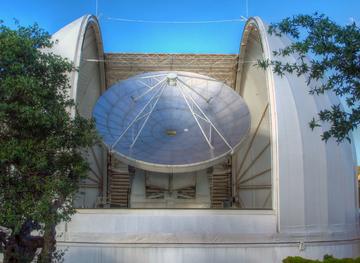
**Kitt Peak 12-meter Telescope**
Kitt Peak, Arizona, USA
altitude: 1,900 m
single dish, 12-m diameter
website:
Operated by the [University of Arizona](https://www.arizona.edu/) ([@UofA](https://twitter.com/UofA), [@uarizona](https://www.facebook.com/uarizona)) through the Arizona Radio Observatory ([ARO](http://aro.as.arizona.edu/)).
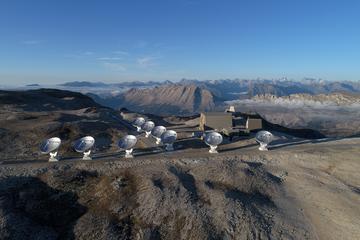
**NOEMA Observatory**
Plateau de Bure, France
altitude: 2,500 m
array of twelve 15-m diameter dishes
web:
Operated by Institut de Radioastronomie Millimétrique ([IRAM](https://www.iram-institute.org/)), a collaboration between Centre National de la Recherche Scientifique ([CNRS](http://www.cnrs.fr/), [@CNRS](https://twitter.com/CNRS), [@CNRS.fr](http://www.facebook.com/CNRS)), [Max-Planck-Gesellschaft](https://www.mpg.de/en) ([@maxplanckpress](https://twitter.com/maxplanckpress), [@maxplancksociety](https://www.facebook.com/maxplancksociety)), and Instituto Geográfico Nacional ([IGN](http://www.ign.es/web/ign/portal), [@IGNSpain](https://twitter.com/IGNSpain), [@IGNSpain](https://www.facebook.com/IGNSpain)).
Share on:- [ Facebook ](#)
- [ Twitter ](#)
- [ Linkedin ](#)